How to Build a Collectible Block Set Collection That's Worth Displaying (and Keeping)
Most how-to guides on building sets for adultsstart at the beginning: pick a set, find a table, sort the pieces. This isn't that guide. If you're reading this, you've probably already finished a few builds. What you're figuring out now is something harder — how to collect with intention, protect your investment, and build a display that actually means something.
This guide covers the collector layer of the hobby: how to evaluate collectible building sets for long-term value before you buy, how to balance build difficulty against display payoff, how to avoid sets that fall apart in practice, and how to build a curated collection on a real budget.
What Actually Makes a Building Set Collectible
Not every adult set earns collector status. “Collectible” gets used loosely in marketing, but it has real criteria.
Subject Matter
Architecture, historically significant vehicles, and cultural landmarks hold value because they connect to something beyond the hobby itself.
Piece Density
A tight 1,200-piece SNOT model often has more display impact than a loosely designed 3,000-piece build with large repetitive sections.
Edition Status
Limited editions, regional exclusives, and discontinued sets carry harder value — in display prestige and resale potential.
How to Evaluate a Set Before You Buy
Impulse purchases are the enemy of a curated collection. Use this three-layer check on any set before committing.
Layer 1 — Structural quality signals
Look for ABS-grade piece descriptions, tight stud tolerance specifications, and consistent color matching in product imagery. Quality-focused brands publish these details.
Layer 2 — Instruction quality
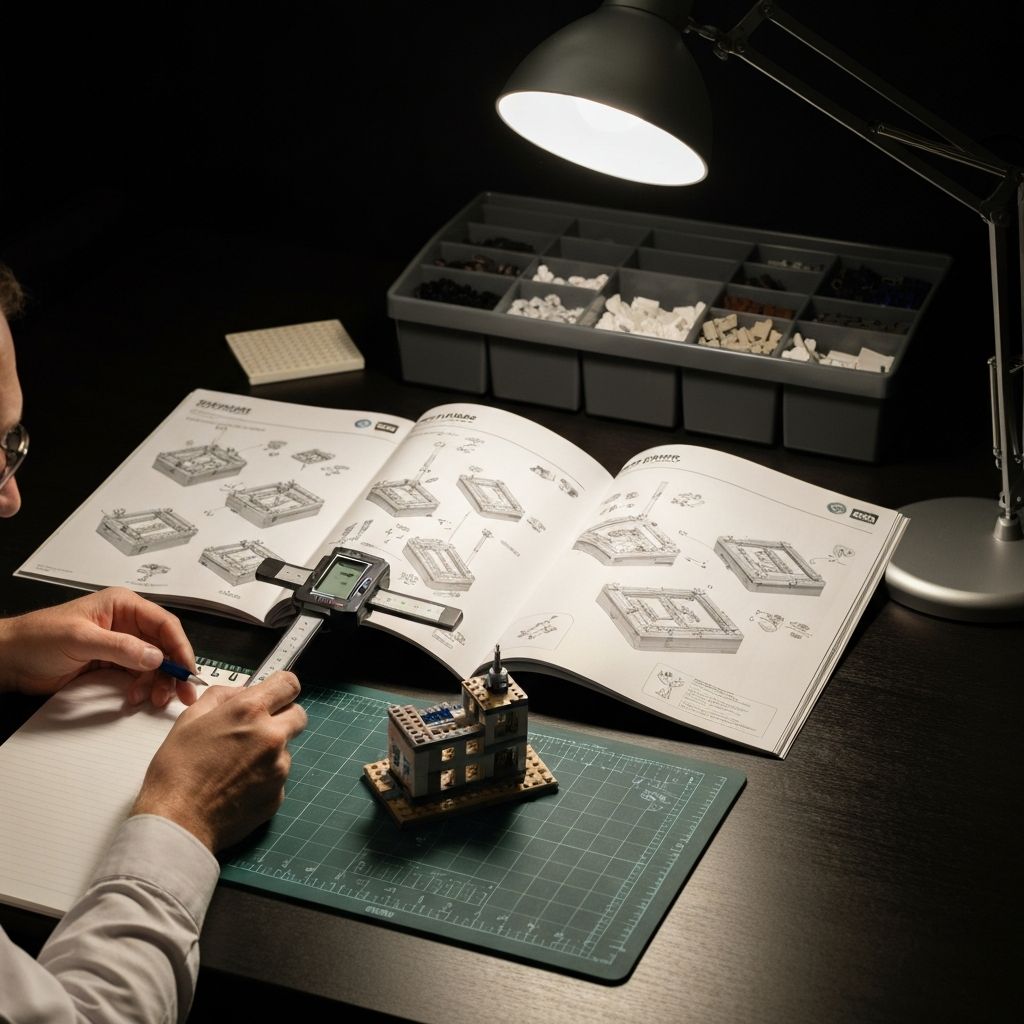
Search for build reviews or in-progress photos in builder communities before buying a new-to-you brand. Ambiguous instruction steps create structurally weak finished models.
Layer 3 — Display dimensions and weight
Check finished model dimensions, not just piece count. Confirm the weight and footprint will work on your planned display surface before it arrives.
For mini building block sets for adults, micro-scale models under 8 inches can look dramatically better than their footprint suggests — if the subject matter is right. A nano-scale space station with 1,400 pieces in a 6-inch cube has more display drama than a large but sparsely detailed vehicle replica. Evaluate these on piece density and subject clarity, not raw size. Browse the full catalog to compare options.
Balancing Build Challenge Against Display Payoff
Some sets are satisfying to build but underwhelming on display. Some look stunning on a shelf but are tedious to assemble. The best sets score on both axes.
| Build Challenge | Display Value | Verdict | Example |
|---|---|---|---|
| High | High | Anchor piece | Expert architecture, cultural replica |
| Lower | High | Rotation piece | Mid-size vehicle, quality micro set |
| High | Moderate | Process build | Technic gear trains, mechanism sets |
| Low | Low | Avoid | Generic snap-together, no detail |
Setting a Collecting Budget That Doesn't Wreck the Hobby
Collector hobbies have a known financial gravity. Budget before you're deep in. Three frameworks that work:
Fixed Monthly Allocation
Set a non-negotiable monthly figure ($60–$120). When it's spent, you wait. Forces prioritization — you buy sets you actually want, not sets that were on sale.
Per-Set Value Threshold
Define a minimum piece-count-to-price ratio. For quality alternative brands, a reasonable baseline is roughly $0.05–$0.08 per piece.
Annual Anchor Purchase
Budget for one flagship set per year (2,500+ pieces). Plan in advance, save specifically for it, give it the display real estate it deserves.
Avoiding Poor-Quality Sets: What to Watch For
Red Flags Before Purchase
- ✕No specific piece count — ranges suggest inconsistent QC
- ✕Unattributed product photography not matching the actual set
- ✕No brand-level customer support or replacement policy
Red Flags After Purchase
- ✕Inconsistent color matching within a single bag
- ✕Studs requiring excessive force or feeling loose — tolerance deviation
- ✕Instructions printed at low resolution with unclear part callouts
At Morebybourn, sets are manufactured to ABS-grade tolerances with full piece-count guarantees and dedicated replacement support — the baseline you should expect from any brand you add to your collection.
Organizing a Curated Collection
A collection without organization isn't a collection — it's accumulation. Curation requires intentional decisions about what stays, what rotates, and what goes.
Anchor Pieces
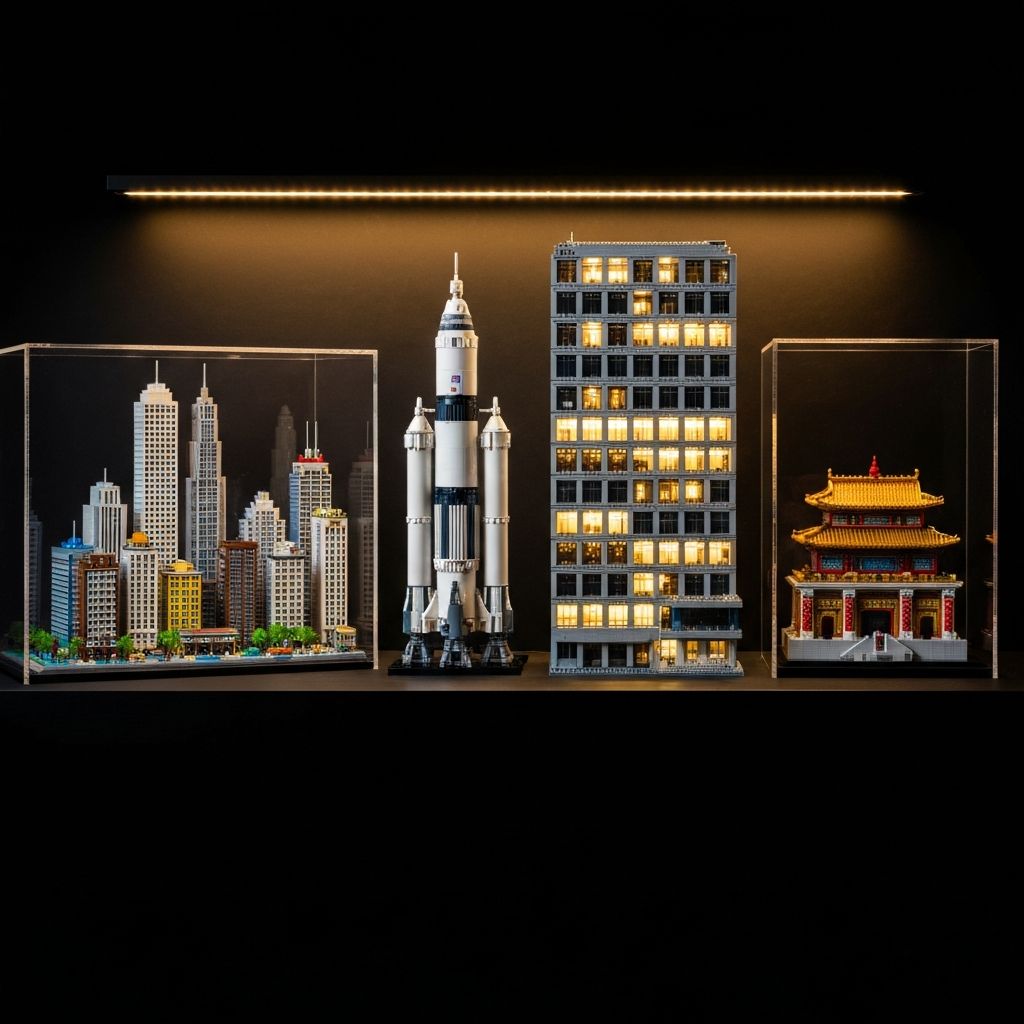
2–3 highest-value models, permanently displayed in acrylic cases. The builds you'd save first.
Rotation Pieces
3–5 mid-tier builds that cycle in and out. Swap seasonally or when a new build completes.
Build Backlog
Sealed sets waiting for their turn. Keep this honest — if a set has sat sealed for two years, ask whether you still want it.
Archive / Resale
Disassemble carefully, bag by colour, store or sell. Proceeds fund new purchases without expanding your budget.
Mini Sets: Shadow Box Strategy
Mini building block sets for adults are compact enough to display in multiples. Group five or six micro-scale models thematically on a single shelf or in a shadow box display case — a city block, a fleet of spacecraft. The visual effect of proximity is often stronger than spacing them individually.
Protecting Long-Term Display Pieces
A build that took 20 hours deserves better than an open shelf in a dusty room. Long-term protection comes down to three factors: UV, dust, and humidity.
UV Exposure
ABS plastic yellows under direct UV. Keep flagship pieces away from direct sunlight. UV-filtering window film is a low-cost protection measure that preserves color fidelity across the whole shelf.
Dust Management
Acrylic display cases offer best protection. Glass-front cabinets suit larger collections. For rotation pieces, use low-pressure compressed air — hold the can upright to avoid moisture deposit.
Structural Integrity
Large builds experience minor structural relaxation over months. Check anchor points periodically. For final-form display models, a light application of display-model adhesive at internal joints locks structure permanently.
Ready to build your collection?
Browse display-grade sets at Morebybourn — with ABS tolerances, full piece-count guarantees, and US warehouse shipping.
Order via WhatsAppConclusion
Collecting building sets as an adultis a different discipline from simply building them. It asks you to evaluate before you buy, protect what you've built, budget with intention, and make deliberate calls about what earns permanent display space. Start by applying the three-layer check to your next purchase. Identify your two or three anchor pieces and protect them properly. Then build the rest of the collection around that core — with the same precision you'd apply to the builds themselves.
Frequently Asked Questions
What distinguishes collectible building sets from standard adult sets?▾
Collectible sets are defined by subject matter with lasting cultural or historical relevance, production quality that holds up over years on display, limited or exclusive availability, and design complexity that signals craft. A collectible set is one you'd still want on your shelf five years from now — not just one that was satisfying to build.
Are mini building block sets for adults worth collecting seriously?▾
Yes — with the right evaluation. Micro-scale sets with high piece density and strong subject matter produce display results that punch above their size. A 1,400-piece nano-scale architectural model in a 6-inch footprint can be a more compelling display piece than a large but loosely designed standard build.
How do I avoid buying a poor-quality set from an unfamiliar brand?▾
Look for three things: a specific piece count (not a range), visible ABS-grade manufacturing specs, and a published missing-piece replacement policy. Then search builder communities for completed build photos from real buyers — these show actual finished quality far more accurately than product photography.
What's the best way to protect a finished build from yellowing?▾
Keep it away from direct sunlight. UV exposure is the primary cause of ABS yellowing. For shelves near windows, apply UV-filtering film to the glass. For anchor pieces, an acrylic display case provides both UV and dust protection. Color fidelity on a well-protected build can hold for a decade or more.
How should I handle complex collectible building sets that I want to display permanently?▾
For builds you'll never disassemble, consider applying a small amount of display-model adhesive at key internal structural joints — not on visible surfaces. This locks the build against structural relaxation over time. Pair this with an acrylic case and UV-filtered light, and a flagship model can remain display-ready indefinitely.