How to Test if Building Block Brands Are Compatible with LEGO
Mixing brick brands sounds simple — studs are studs, right? Not quite. Tolerances vary. Clutch power differs. Some plates fit like a dream. Others wobble or pop loose. This guide gives you a clear, hands-on method to test any brand before you commit a single brick to a build, and answers the most common questions: is FunWhole compatible with LEGO, are base plates compatible to LEGO standard, and is COBI compatible with LEGO.
Why Compatibility Matters Before You Buy
Most adult builders and parents already own LEGO. The real question is not whether a brand is good — it is whether it will work with what you already have. Compatibility affects three things:
Loose bricks ruin large models. A stadium or modular building needs tight joints throughout.
Gaps and slants show up fast on a finished piece. Consistent alignment keeps display surfaces clean.
A brand that mixes well expands your options. One that does not becomes a dead end in your collection.
For builders who want bricks engineered to the LEGO standard from the start, browse the Morebybourn building block collection to see compatible options before testing third-party sets.
The Brick Standard Everyone Builds Around
LEGO bricks follow a precise measurement system. The stud spacing is 8mm center to center. Brick height follows a 5:6 ratio relative to width. These numbers became the unofficial industry benchmark decades ago.
Too wide and bricks will not seat. Too narrow and they slip off. A quality brand stays within 0.1mm of the 4.8mm standard. This single measurement explains most compatibility failures.
The underside tube controls clutch power — the snap you feel when two bricks connect. Strong clutch means a model holds together. Weak clutch means it sags under its own weight.
Is FunWhole Compatible with LEGO?
Yes. FunWhole builds to the standard 8mm stud spacing, so its bricks connect with LEGO and other major brands without issue. FunWhole is known mostly for lighting-integrated sets, with LED components built directly into the structure. The bricks themselves seat well on LEGO plates, and LEGO bricks seat on theirs.
Connections feel firm, not loose. No special tools needed to separate.
FunWhole grays and tans may differ slightly from LEGO shades. Fine for structure; noticeable on visible surfaces.
Light bricks and custom parts are FunWhole-specific. They attach to standard studs but are not LEGO replacements.
Compatible to LEGO Base Plates: What to Check
Base plates are the foundation of any large display. Base plate compatibility comes down to two things: stud spacing and plate thickness.
| Check | Standard Value | Failure Sign |
|---|---|---|
| Stud Spacing | 8mm center to center | Bricks bind partway across the plate |
| Plate Thickness | ~1.4mm | Uneven display height when mixing plates |
| Stud Diameter | 4.8mm | Bricks seat too loosely or won't seat at all |
| Plate Flatness | No bow or warp | Bricks rock or pop off |
- 1Press a LEGO 2x8 brick across a third-party plate.
- 2Check that every stud seats fully.
- 3Run your finger along the brick — it should sit flat with no rocking.
- 4Pull the brick off. Note the clutch — firm but removable is ideal.
You can find base plates and starter bricks built to spec in the Morebybourn base plate range guide, which saves you the guesswork on foundation pieces.
Is COBI Compatible with LEGO?
Yes, with one important note about design language. COBI specializes in military and historical models — tanks, planes, ships. Their bricks connect with LEGO on the same 8mm standard, and clutch power is strong, often slightly tighter than LEGO itself.
8mm stud spacing matches exactly. Clutch is strong — often tighter than LEGO.
COBI figures are a different style and scale from LEGO figures. Mixing looks visually mismatched.
Fine specialized parts for historical realism. Mix with LEGO Technic for functional mechanisms.
Pure brick connection works fine. Full set mixing looks inconsistent in a display context.
How to Test Any Brand at Home
You do not need lab equipment. A few standard bricks and five minutes tell you almost everything. Here is a repeatable test you can run on any new brand.
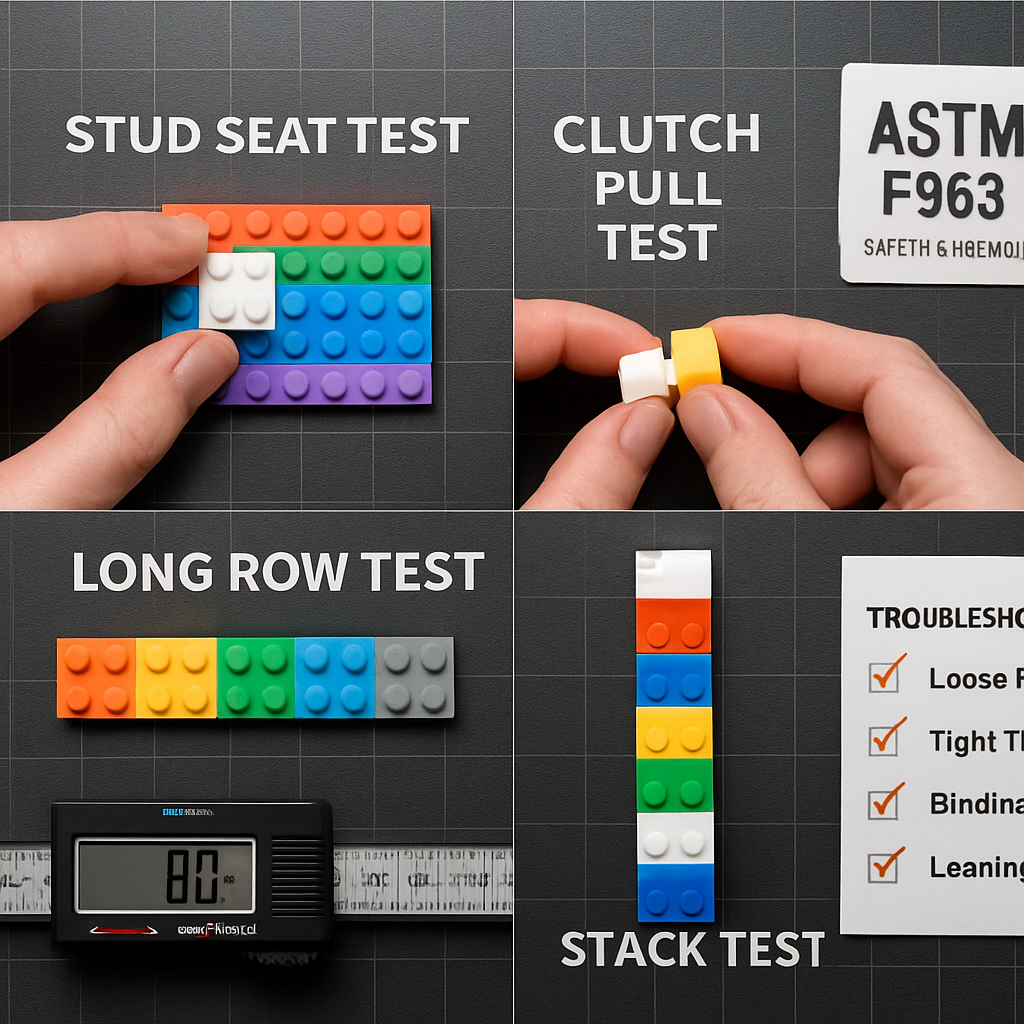
Take a known LEGO brick. Press it onto the new brand's studs. Then reverse it — press the new brick onto LEGO. Both should seat with a clean click, no gap between the brick base and the stud tops. Resistance before seating means the studs are oversized.
Connect the two bricks firmly. Pull them apart. Ideal clutch resists, then releases cleanly. Too easy means weak grip — bad for tall builds. Too hard means tight tolerance — fine for stability, but tough on small fingers.
This is the most revealing test. Build a row of eight to twelve studs using the new brand. Lay a long LEGO plate across the entire row. Every stud should align. Binding halfway signals spacing drift — this is the test short checks miss entirely.
Stack five bricks high, alternating brands. Check for lean. A straight stack means height ratios match. A leaning stack signals a height difference between brands that will compound in large models.
Smart Strategies for Mixing Brands
Pick your most consistent brand for the core build. Stability matters most in the frame.
Bring in other brands for specific colors or specialty pieces you cannot get elsewhere.
Slight color differences show most on flat, exposed faces. Use one brand per visible panel where you can.
If a brand has softer grip, use those pieces in decorative areas, not load-bearing joints.
For builders who want a single consistent brand to anchor large projects, the Morebybourn brick sets comparison guide covers how compatible options pair cleanly with your existing pieces.
Common Compatibility Problems and Fixes
Fix: Clutch power can soften with repeated building. Reserve well-worn bricks for display models. Use fresh bricks for pieces you rebuild often.
Fix: This is a sourcing issue, not a fit issue. Buy color-critical pieces from one brand in a single order. Production batches can vary even within a brand.
Fix: Some plates have slightly different edge profiles. Build inward from one corner rather than trying to align all edges at once.
Fix: Custom parts like hinges, clips, and brackets vary most between brands. Test these individually. Standard bricks rarely fail; specialty parts sometimes do.
A Quick Buyer's Checklist
- Does the brand state it uses 8mm stud spacing?
- Are reviews mentioning clutch power positive?
- Do you need exact LEGO color matching, or is structural use fine?
- Will you mix it into existing builds, or keep it standalone?
- Are the specialty pieces ones you actually need?
Browse LEGO-Compatible Bricks at Morebybourn
All bricks built to the 8mm standard — strong clutch, quality ABS, fast US and EU shipping. Browse the range or ask a compatibility question directly.