How to Identify and Shop for Display-Worthy Collectible Building Sets That Are Actually Worth It
Most collectors have made the same mistake. You see a high piece count, a dramatic box render, and a reasonable price — and you order. Then the finished model sits on your shelf looking flat, losing pieces, and fading in your estimation week by week. The problem wasn't the price. It was the criteria. This guide cuts straight to what separates a genuinely display-worthy collector build from a forgettable one — and how to shop for complex collectible building sets strategically so you stop overpaying for sets that underdeliver.

Why Display Value and Build Satisfaction Are Two Different Things
Experienced builders know this intuitively. A set can be deeply satisfying to build — clever subassemblies, interesting techniques, satisfying click-in moments — and still produce a finished model that looks unremarkable from four feet away. The best collectible building sets deliver both. When evaluating complex collectible building sets for sale, assess these two dimensions separately.
Build Satisfaction Comes From
- Structural variety — subassemblies that feel distinct
- Technique diversity — new piece application every 100 steps
- Logical progression — each stage advances the model visibly
- Satisfying completion moments — section closes, form becomes recognizable
Display Value Comes From
- Visual complexity at distance — texture and depth that reads from across the room
- Color cohesion — a palette that looks intentional
- Dimensional presence — genuine physical scale and clear dominant axis
- Detail density — surface interest that rewards closer inspection
Step 1: Evaluate Artistic Design Before Piece Count
The piece count on the box is a marketing number. It tells you volume; it doesn't tell you composition. For display-worthy builds, artistic design is the primary indicator of finished shelf presence.
Look at the Finished Model From Multiple Angles
Marketing renders almost always show the model from its strongest angle. Find community builds, review photos, or secondary render views that show the model from the side, the rear, and from slightly above. A model that looks dramatic from the front but featureless from the side has limited placement flexibility.
Assess the Color Story
Strong collector builds have a deliberate color architecture. For lego art love collectible building sets — sets that lean into artistic themes, mosaics, or architectural beauty — color is even more central. Zoom out from any product photo until the model fills roughly the same apparent size as it would on a shelf twelve feet away. Does it still hold its visual identity?
Identify the Dominant Visual Feature
Every great display model has one thing that anchors it — an architectural curve, a vehicle silhouette, a mechanical element that draws the eye. If you can't identify it immediately from product photos, the design lacks a focal point. That's a structural problem no shelf placement will fix.
Step 2: Match Emotional Theme to Long-Term Display Intent
Collector sets aren't bought once and replaced seasonally. They occupy shelf real estate for months or years. That means the theme has to hold. Here are the theme categories ranked by long-term display staying power:
| Theme Category | Long-Term Display Rating | Notes |
|---|---|---|
| Architecture | Excellent | Timeless by definition — doesn't date |
| Original Mechanical Subjects | Excellent | Engines, spacecraft, maritime — not tied to cultural moment |
| Classic Vehicle Profiles | Very Good | Vintage autos, historic aircraft — iconic silhouettes age well |
| Mosaic / Art-Format | Very Good | Lego art love segment — functions as genuine shelf artwork |
| Trend-Dependent Pop Culture | Variable | Buy for build experience, not display longevity |
Step 3: Understand What Drives Price in the Collector Market
Serious collectors shopping for the best alternatives to LEGO for adults need to understand what they're actually paying for — because not all premium pricing reflects premium quality.
What Justifies Higher Cost
- Specialty elements — printed tiles, custom molded shapes, rare piece variants
- Instruction manual quality — clear contrast, logical subassembly grouping
- Tight piece tolerances — consistent clutch power across the set
- Part range diversity — 180+ distinct part variants vs 40 at high repetition
What Doesn't Justify Premium Pricing
- Brand name premiums — specialist brands come in 40–60% below mainstream at equal quality
- Licensed theme markups — licensing fees are passed directly to buyers
- Retailer intermediary margins — buying direct eliminates at least one markup tier
Step 4: How to Shop Strategically for Serious Hobby Builds
Where to buy complex collectible building sets is a question with a short answer and a longer one. Short answer: direct from specialist collector brands. Here's the full breakdown:
Direct Specialist Brand Websites
BestBest for: Flagship builds, accurate inventory, proper warranty, missing-piece replacement guarantees
Risk: Requires international shipping patience for some regions
Hobby Retailers (Physical & Online)
GoodBest for: Mid-tier sets, gift purchases, hands-on assessment, immediate local availability
Risk: Flagship collector builds often limited-stock and inconsistently stocked
Third-Party Marketplaces
CautionBest for: Price comparison, discontinued models, secondary-market collector pieces
Risk: Counterfeits, misdescribed parts, no missing-piece support for collector-tier purchases
Step 5: Gifting Collector Sets — How to Buy Right for Someone Else
Collector-tier builds are excellent gifts when matched correctly. They fail when they're not. Three principles to follow:
Skill-Match First
Target one complexity tier below the recipient's most recently completed build. It's better to give a set they complete confidently than a box that intimidates them into a three-month shelf stall.
Theme Over Piece Count
A 1,800-piece architectural set centered on a building style the recipient loves will be more meaningful than a 4,500-piece mechanical build they feel neutral about.
Read the Giftability Signals
Clean box presentation, included display stand or nameplate, and quality instruction manual. Sets with sticker-based details and low-quality booklets make poor gifts regardless of technical merit.
Step 6: US and European Buyer Considerations
US Buyers
- Confirm whether the seller handles import duties at order time
- Reputable brands collect final landed cost at checkout — no charges at the door
- Total billed at checkout = total you pay
- Build time for flagships: 8–20+ hours across multiple sessions
- Standard international shipping: 7–20 business days
European Buyers
- Confirm IOSS compliance before ordering from non-EU sellers
- IOSS-registered sellers collect VAT at checkout — no customs hold
- UK buyers: orders above £135 trigger duty assessment post-Brexit
- Verify current rates and responsibility before placing large orders
- Plan gifting timelines with shipping windows in mind
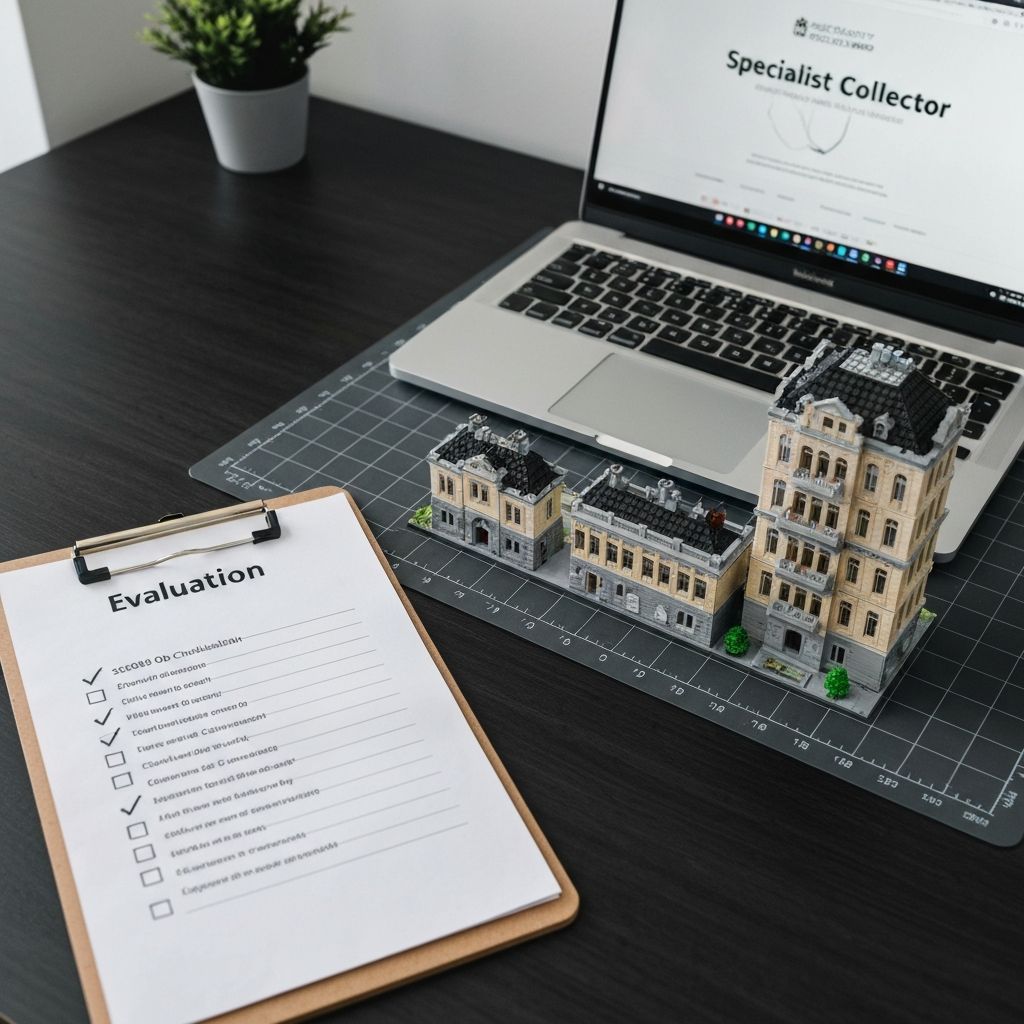
The Collector's Evaluation Checklist
Before any collector-tier purchase, run through this:
- Identified the dominant visual feature of the finished model
- Confirmed display value from at least two viewing angles
- Assessed theme for long-term shelf staying power
- Verified printed (not sticker) detail elements
- Confirmed piece tolerance and color consistency via community reviews
- Understood total landed cost including duties and VAT
- Matched complexity tier to builder skill level (if gifting)
- Verified missing-piece replacement policy
- Confirmed shipping timeline against any date deadline